Wednesday, September 28, 2016

Read a Banned Book Lately?

Banned Book Week 2016 is THIS WEEK, September 25-October 1, so hurry in if you are a purist and want to read your banned book(s) during the official commemoration. If you are less orthodox in your observance, feel free to come by the library any time and we will help you find something racy, salacious, and/or thought-provoking to explore.

Currently we have a display of some of the books in the Dewey 000-339 range that have been banned or challenged to help you select your next read. Lucky for us the books ABOUT banned books are also in our room at Dewey 025.213 & .218 (remember to check the reference shelves too!), facilitating our search for good nonfiction titles. We pulled a couple of those for the display and you can check them out (either literally with your library card, or just flip through one of them for further recommendations). And if fiction is more your style, visit our friends in Center for the Reader on the 1st floor of Central and take a look at their display.

One of the books on display is Studs Terkel's 1974 book Working: People Talk About What They Do all Day and How They Feel About What They Do, which was challenged and removed from school curricula and reading lists in the 1970s and 80s due to obscene/profane language (Robert P. Doyle, Banned Books - Challenging Our Freedom to Read, Aspen Printing Co., 2014).

Working consists of over 100 interviews with people from all walks of life and in a nice coincidence NPR, in conjunction with Radio Diaries and Project &, is running a series, "'working' then and now," which includes excerpts from the interviews. This morning they played part of the interview with a woman they called Barbara Herrick (per the radio story, a pseudonym) - you can find her story about working as a female executive at a large ad agency in the 1970s at page 66 of the book on our display.

Twitter shared one more example of contemporary book banning with this Slate story about the Texas Department of Criminal Justice's practice of denying prisoners access to certain books (from their list of almost 15,000) for one of six reasons, including "a prohibition against books determined to have been written 'solely for the purpose' of achieving the breakdown of prisons through strikes, riots, or gang activity - [which] permits the prison to ban pretty much any book about civil rights that uses the [n-word]." [yes, the irony of editing out an offensive word in a blog post about banned books is not lost on me...]

We invite you to visit a library near you and pick up a book that meets one or more of the criteria in the word cloud below, and stand up for YOUR right to read!
 

Wednesday, September 21, 2016

Happy International Day of Peace!

"Let us all work together to help all human beings achieve dignity and equality;
to build a greener planet; and to make sure no one is left behind."

Today we observe the International Day of Peace, as declared by the United Nations General Assembly: “a day devoted to strengthening the ideals of peace, both within and among all nations and peoples” with the 2016 theme: “The Sustainable Development Goals: Building Blocks for Peace.”

The 193 U.N. member states unanimously adopted the 17 Sustainable Development Goals (below in graphic form, or click the link for the hip-hop video on YouTube) a year ago in September 2016, and the U.N. website declares them “integral to achieving peace in our time, as development and peace are interdependent and mutually reinforcing.”


We have many “peace” titles in the Social Sciences room (see primarily Dewey 303, but also 201 or 261), as well as books on sustainable development (338, or in the next room at 363) - come visit us, check them out, and let's all do our part to achieve peace in our time.


Friday, September 2, 2016

Happy Labor Day Weekend!


Remember - the Library will be closed on Monday, September 5, 2016 for Labor Day. 

To help our patrons celebrate - and remember what this holiday is all about - we've put together a book display in the Social Sciences room at Central Library that we will (most likely) keep up for most of September. Come take a look at it, and maybe check out a book or two to enjoy at home. We also have some great reference books on the subject, 2 of which are pictured here.

As a rule, the books on labor and unions are at Dewey 331.8(ish) - so in the beautiful wooden shelves under the windows looking east toward Christ Church Cathedral for circulating books, and in the beautiful wooden shelves on the interior west wall for the reference books.  

In addition to the great resources at the Library, we recommend that you explore the St. Louis Federal Reserve Bank's FRASER digital archives, a rich source of primary source material on all things economic, including labor matters. Click here for a recent explanatory post about the Bureau of Labor Statistics unemployment numbers.

Finally (before we let you go enjoy your Labor Day BBQ), here is some information on Labor Day and U.S. employment related numbers from the U.S. Census Bureau.


Chart

The first observance of Labor Day was likely on Sept. 5, 1882, when some 10,000 workers assembled in New York City for a parade. The parade inspired similar events across the country, and by 1894 more than half the states were observing a “workingmen’s holiday” on one day or another. Later that year, with Congress passing legislation and President Grover Cleveland signing the bill on June 29, the first Monday in September was designated “Labor Day.” This national holiday is a creation of the labor movement in the late 19th century and pays tribute to the social and economic achievements of American workers.

Who Are We Celebrating?

158.5 million
The number of people age 16 and over in the nation’s labor force as of May 2016.

16.4 million
The number of wage and salary workers age 16 and over represented by a union in 2015. This group included both union members (14.8 million) and workers who reported no union affiliation but whose jobs were covered by a union contract (1.6 million). Among states, New York continued to have the highest union membership rate (24.7 percent), and South Carolina had the lowest rate (2.1 percent).  

Source: U.S. Bureau of Labor Statistics

  Table 5. Union affiliation of employed wage and salary workers by state


15.2 million

The number of employed female workers age 16 and over in service occupations in 2014. Among male workers age 16 and over, 11.8 million were employed in service-related occupations. 

1.9%
The percentage increase in employment, or 141.9 million, in the U.S. between December 2014 and December 2015. In December 2015, the 342 U.S. counties with 75,000 or more jobs accounted for 72.5 percent of total U.S. employment and 77.8 percent of total wages. These
342 counties had a net job growth of 2.2 million over the year, which accounted for 81.4 percent of the overall U.S. employment increase. 

Another Day, Another Dollar

$50,383 and $39,621
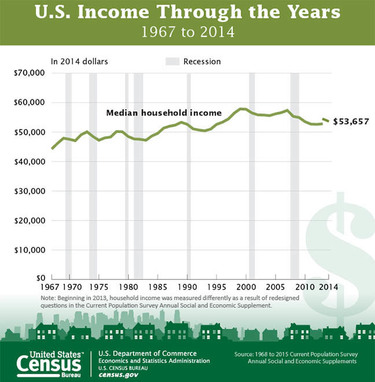
The 2014 real median earnings for male and female full-time, year-round workers, respectively. The 2014 real median household income of $53,657 is not statistically different in real terms from the 2013 median of $54,462.

The Commute to Work

6.3 million
The number of commuters who left for work between midnight and 4:59 a.m. in 2014. They represented 4.5 percent of all commuters. The most common time was between 7 a.m. and 7:29 a.m. – with 20.6 million commuters.
Source:U.S. Census Bureau, 2014 American Community Survey, Table B08132                                              

76.5%

The percentage of workers age 16 and over who drove alone to work in 2015. Another 9.2 percent carpooled and 0.6 percent biked to work.


Source: U.S. Census Bureau, 2014 American Community Survey, Table S0801                                                
26.0 minutes
The average time it took workers in the U.S. to commute to work in 2014. New York (32.6 minutes) and Maryland (32.3 minutes) had the most time-consuming commutes.