Monday, October 31, 2016

Trick or Treat for Democracy

For Halloween the Social Sciences Librarian chose to dress as a "Golden Lane" suffragist, honoring the women who made inroads toward universal U.S. suffrage when they gathered in St. Louis from around the country in 1916 to stage a protest at the Democratic National Convention. Dressed all in white with yellow sashes, the ladies silently (but reproachfully) lined Locust Street, the path the male conventioneers took from their hotel, in what came to be known as the "Golden Lane". The Democrats included a women's suffrage plank in the 1916 platform and eventually the 19th Amendment was passed (Missouri was the 11th state to ratify) and white women, at least, were able to vote.

At St. Louis Public Library you can check out the book about that event and the women who made suffrage a reality (#Dewey 324.6230977). The book includes a chapter on Virginia Minor (1824-1894), whose identity the Librarian adopted for the day (even though she was no longer around for the "Golden Lane"). Mrs. Minor sued (with her husband/in his name, as she could not bring suit as a woman) for the right to vote in the presidential election and their suit went to the U.S. Supreme Court which ruled unanimously against the Minors in 1875. She was the first president of the St. Louis Suffrage Association when she died she left half of her estate to Susan B. Anthony "in gratitude for the many thousands she has expended for women" and the remainder to two unmarried nieces with the instruction that if either married, her share would revert to the unmarried niece.

Of course true universal suffrage would not be achieved until much later in the 20th century when African-Americans were finally able to vote after the hard-won fight for civil rights. For information regarding the Black women's suffrage movement, see African American Women in the Struggle for the Vote by Rosalyn Terborg-Penn at #Dewey 324.623089.

For your further edification and/or entertainment, please see the 2015 article from the Columbia Journalism Review exploring the difference between the terms "suffragist" and "suffragette" and from Disney's Mary Poppins (DVD available at St. Louis Public Library, along with book, e-book & audiobook), the classic "Sister Suffragette" - and please, remember to VOTE! 


Thursday, October 27, 2016

ELECTION 2016 - Resources for the Informed Missouri Voter (like YOU!)

There is a LOT on the Missouri ballot this November 8 - the St. Louis City ballot, for example, in addition to the Presidential race also has
  • U.S. Senate
  • U.S. House of Representatives
  • FIVE statewide offices (Governor, Lt. Governor, Secretary of State, Attorney General, & Treasurer)
  • FIVE state amendments 
  • One state proposition
  • One City proposition
  • State Senator
  • State Representative 
  • Three City candidates (circuit attorney, sheriff & treasurer - remember, the August vote was the primary!) AND
  • Judges up for retention votes
So before you go to vote (Missouri polls open at 6:00 a.m. & are open until 7:00 p.m.), study up and decide how you are voting, and confirm your registration & polling place at the Missouri Secretary of State’s website (make sure you know where you are going!) The Missouri Secretary of State has also launched a "voter outreach" site where you can plug in your address and see who and what is on your ballot, and will also show where you are supposed to go vote.


To assist with the "study up and decide" task, here are some resources:


The League of Women Voters is a nonpartisan political organization that encourages informed and active participation in government, works to increase understanding of major public policy issues, and influences public policy through education and advocacy. Go to the LWV/St. Louis Post-Dispatch Voters Guide & plug in your address or use your location to pull up the St. Louis Post-Dispatch Voters Guide, customized to show only what will be on your ballot on Nov. 8 (uncustomized hard copies available at the Library as well or in your Oct. 28 newspaper).
"Ballotpedia is the online encyclopedia of American politics and elections. [Their] goal is to inform people about politics by providing accurate and objective information about politics at all levels of government." Go to https://ballotpedia.org/Sample_Ballot_Lookup & enter your full address with zip code for a sample ballot with lots of good background info.

St. Louis Public Radio’s Politically Speaking podcast has interviews with most, if not all, of the statewide and local candidates – hear what they have to say about their positions on important issues.
To learn more about the performance of the judges who will be on your Nov. 8 ballot for a retention vote, see the Missouri Bar judicial “scorecard” (link is to judges for City's 22nd Circuit; for County see 21st Circuit). 


The Missouri Secretary of State’s website also has the ballot language, “fair ballot language,” and links to PDFs of the full text of the five amendments and one state proposition on the ballot (& don't forget the City proposition!).


We will add new resources as we hear of them (so give us a head's up if we're missing something by emailing the Social Sciences librarian) - for example, here is a guide to the MO ballot measures from St. Louis Magazine.


Here are some other good resources (what are your favorites?)


Wednesday, October 12, 2016

Zines at Central Library!

St. Louis Public Library has added a collection of zines to the Entertainment, Literature & Biography Room & is celebrating with a grand opening this Thursday October 13, 2016. Click here for more information.

What is a zine, you ask? According to early "ziner" Malcolm Gladwell (in interview with Vox's Ezra Klein), "A zine is a homemade magazine — it’s what you did if you lived in a small town and had some pretensions to cultural importance. You ran your own magazine and ran it off on a Xerox machine and distributed it to your friends. Lots of people had zines in the ’70s and ’80s." When he was 15, Gladwell and some friends had a zine called Ad Hominem: A journal of slander and political opinion. Many of Gladwell's more recent works, including Blink (Dewey 153.44), The Tipping Point (302), and Outliers (302) are available at St. Louis Public Library in paper and digital formats.

You can learn more about zines by coming to Central and exploring the new collection, or check out the book Make A Zine! - A Guide to Self-Publishing Disguised as a Book on How to Produce a Zine (Dewey 070.572) or for interested kids, zine scene (J070.5720285). You may also want to visit the St. Louis Small Press Expo which is happening at Central on October 15, 2016.


Wednesday, September 28, 2016

Read a Banned Book Lately?

Banned Book Week 2016 is THIS WEEK, September 25-October 1, so hurry in if you are a purist and want to read your banned book(s) during the official commemoration. If you are less orthodox in your observance, feel free to come by the library any time and we will help you find something racy, salacious, and/or thought-provoking to explore.

Currently we have a display of some of the books in the Dewey 000-339 range that have been banned or challenged to help you select your next read. Lucky for us the books ABOUT banned books are also in our room at Dewey 025.213 & .218 (remember to check the reference shelves too!), facilitating our search for good nonfiction titles. We pulled a couple of those for the display and you can check them out (either literally with your library card, or just flip through one of them for further recommendations). And if fiction is more your style, visit our friends in Center for the Reader on the 1st floor of Central and take a look at their display.

One of the books on display is Studs Terkel's 1974 book Working: People Talk About What They Do all Day and How They Feel About What They Do, which was challenged and removed from school curricula and reading lists in the 1970s and 80s due to obscene/profane language (Robert P. Doyle, Banned Books - Challenging Our Freedom to Read, Aspen Printing Co., 2014).

Working consists of over 100 interviews with people from all walks of life and in a nice coincidence NPR, in conjunction with Radio Diaries and Project &, is running a series, "'working' then and now," which includes excerpts from the interviews. This morning they played part of the interview with a woman they called Barbara Herrick (per the radio story, a pseudonym) - you can find her story about working as a female executive at a large ad agency in the 1970s at page 66 of the book on our display.

Twitter shared one more example of contemporary book banning with this Slate story about the Texas Department of Criminal Justice's practice of denying prisoners access to certain books (from their list of almost 15,000) for one of six reasons, including "a prohibition against books determined to have been written 'solely for the purpose' of achieving the breakdown of prisons through strikes, riots, or gang activity - [which] permits the prison to ban pretty much any book about civil rights that uses the [n-word]." [yes, the irony of editing out an offensive word in a blog post about banned books is not lost on me...]

We invite you to visit a library near you and pick up a book that meets one or more of the criteria in the word cloud below, and stand up for YOUR right to read!
 

Wednesday, September 21, 2016

Happy International Day of Peace!

"Let us all work together to help all human beings achieve dignity and equality;
to build a greener planet; and to make sure no one is left behind."

Today we observe the International Day of Peace, as declared by the United Nations General Assembly: “a day devoted to strengthening the ideals of peace, both within and among all nations and peoples” with the 2016 theme: “The Sustainable Development Goals: Building Blocks for Peace.”

The 193 U.N. member states unanimously adopted the 17 Sustainable Development Goals (below in graphic form, or click the link for the hip-hop video on YouTube) a year ago in September 2016, and the U.N. website declares them “integral to achieving peace in our time, as development and peace are interdependent and mutually reinforcing.”


We have many “peace” titles in the Social Sciences room (see primarily Dewey 303, but also 201 or 261), as well as books on sustainable development (338, or in the next room at 363) - come visit us, check them out, and let's all do our part to achieve peace in our time.


Friday, September 2, 2016

Happy Labor Day Weekend!


Remember - the Library will be closed on Monday, September 5, 2016 for Labor Day. 

To help our patrons celebrate - and remember what this holiday is all about - we've put together a book display in the Social Sciences room at Central Library that we will (most likely) keep up for most of September. Come take a look at it, and maybe check out a book or two to enjoy at home. We also have some great reference books on the subject, 2 of which are pictured here.

As a rule, the books on labor and unions are at Dewey 331.8(ish) - so in the beautiful wooden shelves under the windows looking east toward Christ Church Cathedral for circulating books, and in the beautiful wooden shelves on the interior west wall for the reference books.  

In addition to the great resources at the Library, we recommend that you explore the St. Louis Federal Reserve Bank's FRASER digital archives, a rich source of primary source material on all things economic, including labor matters. Click here for a recent explanatory post about the Bureau of Labor Statistics unemployment numbers.

Finally (before we let you go enjoy your Labor Day BBQ), here is some information on Labor Day and U.S. employment related numbers from the U.S. Census Bureau.


Chart

The first observance of Labor Day was likely on Sept. 5, 1882, when some 10,000 workers assembled in New York City for a parade. The parade inspired similar events across the country, and by 1894 more than half the states were observing a “workingmen’s holiday” on one day or another. Later that year, with Congress passing legislation and President Grover Cleveland signing the bill on June 29, the first Monday in September was designated “Labor Day.” This national holiday is a creation of the labor movement in the late 19th century and pays tribute to the social and economic achievements of American workers.

Who Are We Celebrating?

158.5 million
The number of people age 16 and over in the nation’s labor force as of May 2016.

16.4 million
The number of wage and salary workers age 16 and over represented by a union in 2015. This group included both union members (14.8 million) and workers who reported no union affiliation but whose jobs were covered by a union contract (1.6 million). Among states, New York continued to have the highest union membership rate (24.7 percent), and South Carolina had the lowest rate (2.1 percent).  

Source: U.S. Bureau of Labor Statistics

  Table 5. Union affiliation of employed wage and salary workers by state


15.2 million

The number of employed female workers age 16 and over in service occupations in 2014. Among male workers age 16 and over, 11.8 million were employed in service-related occupations. 

1.9%
The percentage increase in employment, or 141.9 million, in the U.S. between December 2014 and December 2015. In December 2015, the 342 U.S. counties with 75,000 or more jobs accounted for 72.5 percent of total U.S. employment and 77.8 percent of total wages. These
342 counties had a net job growth of 2.2 million over the year, which accounted for 81.4 percent of the overall U.S. employment increase. 

Another Day, Another Dollar

$50,383 and $39,621
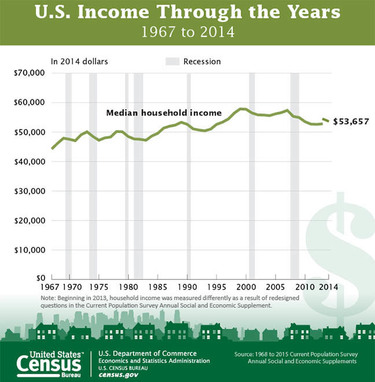
The 2014 real median earnings for male and female full-time, year-round workers, respectively. The 2014 real median household income of $53,657 is not statistically different in real terms from the 2013 median of $54,462.

The Commute to Work

6.3 million
The number of commuters who left for work between midnight and 4:59 a.m. in 2014. They represented 4.5 percent of all commuters. The most common time was between 7 a.m. and 7:29 a.m. – with 20.6 million commuters.
Source:U.S. Census Bureau, 2014 American Community Survey, Table B08132                                              

76.5%

The percentage of workers age 16 and over who drove alone to work in 2015. Another 9.2 percent carpooled and 0.6 percent biked to work.


Source: U.S. Census Bureau, 2014 American Community Survey, Table S0801                                                
26.0 minutes
The average time it took workers in the U.S. to commute to work in 2014. New York (32.6 minutes) and Maryland (32.3 minutes) had the most time-consuming commutes.

Friday, August 26, 2016

Gateway to Well-being

Conf info
St. Louis Public Library is excited to take part in Yoga Buzz's Gateway to Well-being festival on Saturday, September 3 on the downtown St. Louis riverfront from 8 a.m.-4 p.m. In anticipation we in the Social Sciences room have gathered some titles on well-being for some one-stop wellness shopping - come by if you want to do some advance reading for the festival. In addition to our books, which you can check out with your St. Louis Public Library card, we have some great periodicals, including those pictured here. Perhaps you are a boddhisatva (one on the path to awakening/enlightenment) - or want to be? Come in and curl up with the Fall 2016 Buddhadharma for some tips. Or pick up the Lion's Roar for some mindfulness guidance. Or just come to the riverfront on the first Saturday in September and learn what we have to offer.

Namaste!


Wednesday, August 10, 2016

Who doesn't love wisdom? Philosophy 101 at St. Louis Public Library


Philosophy books make up a fair portion of the collection in the Social Sciences Room at Central Library, so we thought we would pull a few titles from the Dewey Decimal System 100s to let our patrons do a little philosophical exploration.

Grab a book and dip your toe in - if you decide you want to do a deep dive, we'd be happy to show you to the 110s (metaphysics), 120s (epistemology), 140s (philosophical schools of thought), 160s (philosophical logic), 170s (ethics), 180s (ancient, medieval & eastern philosophy), & 190s (modern western philosophy). And if the Cartoon Introduction to Philosophy has already been checked out, the good news is it is also available in e-book form - just check the slpl.org catalog. Enjoy!


Friday, August 5, 2016

Celebrate the Vote & Save the Date for A Centennial Celebration of the Golden Lane


In 1916, over 3000 suffragists converged on Saint Louis, Missouri in the sweltering heat for the Democratic National Convention to demand that a plank be included in the party platform in support of women's suffrage. The women wore white dresses and golden sashes that said “Votes for Women” and lined Locust Street where the delegates would walk from the Jefferson Hotel to the convention center. Their “walkless talkless parade” would become known as “The Golden Lane” and they accomplished their objective, as this was included in the 1916 Democratic platform (from p. 21 of the National Democratic Party's Democratic Text Book - 1916):

“We recommend the extension of the franchise
to the women of the country
by the States upon the same terms as to men.”

The League of Women Voters of Metro St. Louis is hosting a centennial celebration at Central Library on Saturday, September 3:


10:00         Music
10:30         Join the parade! Wear white like the 1916 suffragists. Or, just be yourself - which is part of what the suffragists were fighting for.
11:00         Speakers
11:30-2      Food, Shopping, Voter Registration, Music, Movies, and More


In anticipation of the celebration, we have gathered some books from our shelves about the struggle for the vote and the accomplishments women have achieved since the 19th Amendment passed. One treasure we found in the stacks is Women are People! by Alice Duer Miller, a slim 1917 volume of verse and essays, many of which were published in the New York Tribune.


Here is one of the poems, from the section "Our Friend the Enemy" - and some pictures of our book display. Hope you come visit us if you come to the celebration - or any time you are downtown.


Her Representative

"I represent my wife," he said;
"I really cannot see
How she would profit by the vote;
I vote for her and me.
And men consider - Time has shown -
Their wives' opinions like their own.


"If my wife voted she would vote
For many silly measures,
Which do not add in any way
To profits or to pleasures;
Like Widows' Pensions, Equal Pay,
More schools, and an eight-hour day.


"On Woman Suffrage I vote no;
Perhaps you had not heard
My wife believes in that as well;
How wicked and absurd!
Oh let us save domestic strife,
And let me represent my wife!"


Thursday, July 14, 2016

It's Not All Black & White - SLPL Materials on Race, What It Means in Our Society, & What We Can Do


An explanation of #BlackLivesMatter, in 24 words:

“Hey everyone. It hurts when police officers shoot us. Because we’re human. And sometimes we die. Which really sucks. So stop doing that, please.”

In response to the recent killings in Baton Rouge, suburban Minneapolis, and Dallas, we have pulled some titles from our shelves for a book display. We would like to be part of the conversation about race, policing, guns, and how to make our neighborhoods, our city, our country, and the world (why not aim high, right?) better places for everyone to live. Hopefully some of the books will make their way home with patrons, open some minds, challenge some preconceptions, move some people out of their comfort zone (or better - expand their comfort zone), and prompt some discussions. Happy that a few have already wandered off - but don't worry, we will be regularly restocking the cart. We also have a number of periodicals and reference materials that are relevant – pictured are a few newspapers and magazines currently on our shelves that you are welcome to come in and read.


In addition to all the materials available at the Library (& don’t forget our downloadables and audiobooks), there is a lot of great information “out there.” (Also a lot of misinformation & nonsense, so be careful.) Here are links to a couple of podcasts on the topic of race (one local to St. Louis, one national) that you may find of interest:
And finally (for now), here is a link to Diversity Awareness Partnership's infographic: "4 Steps to Being a White Ally" which we saw recently on Twitter. DAP's vision: "inclusive communities where diversity is respected and embraced, and equity is the norm." You can follow DAP at @inclusivestl (& while you are at it, perhaps you'd like to follow us as well at @SLPLsocsci).

Be well, stay cool, & come check us out.